
Seven-Stage Traceability Lifecycle for VCM Editor
An audit-first breakdown of establishing immutable stock reads, capturing precise parameter offsets, maintaining change rationale, and recording post-flash diagnostic verification.
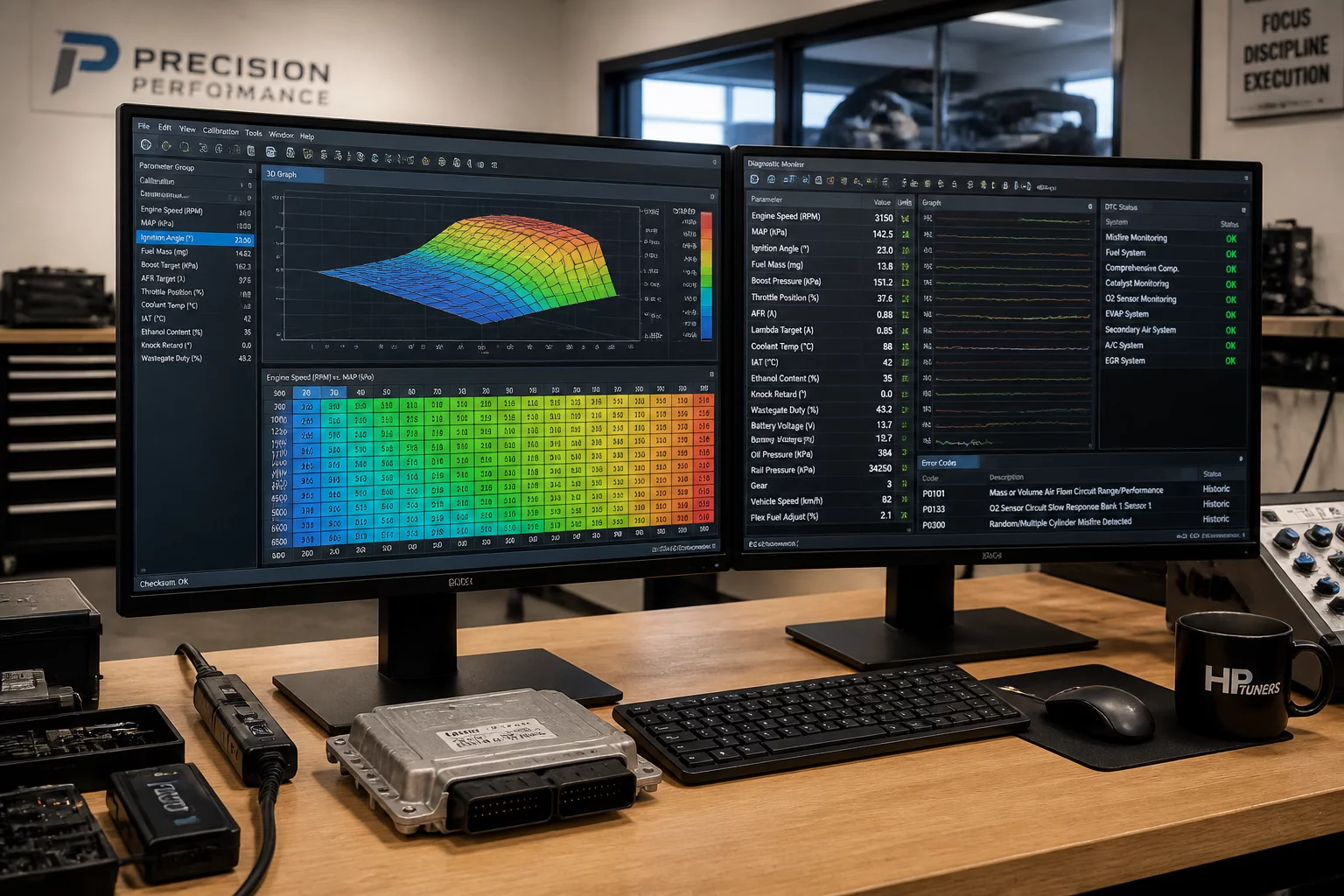
Never edit a primary read file in place. Calibration integrity requires complete historical separation between binary baselines and active revision branches.
Original Binary Read & Hardware Verification
Execute a complete memory extract through the diagnostic interface. Verify controller hardware part numbers, operating system IDs, and calibration segment checksums prior to file storage.
- Verify matching OS and calibration IDs in the hardware summary pane.
- Confirm no unrecorded pre-existing trouble codes reside in persistent memory.
Product Boundary
HP Tuners VCM Editor is the third-party calibration environment referenced in this guide.
CalibrationDiff Ledger independently publishes documentation and change-traceability methods.
The site does not provide calibration files, recommended tuning values, flashing services, emissions defeat instructions, safety-system bypasses, licensing credits, vehicle access, or official HP Tuners support.
Independent Educational Notice & Compliance Disclaimer
CalibrationDiff Ledger is an independent educational publication and is not affiliated with or endorsed by HP Tuners.
HP Tuners, VCM Scanner, and VCM Editor are referenced only to explain documented software workflows.
Any vehicle calibration activity must comply with applicable emissions, safety, and transportation laws.
HP Tuners directly states that its tools must not be used as defeat devices and must be applied in compliance with applicable emissions requirements. hptuners.com
For our organizational governance rules, please review our Disclaimer and Terms of Use.