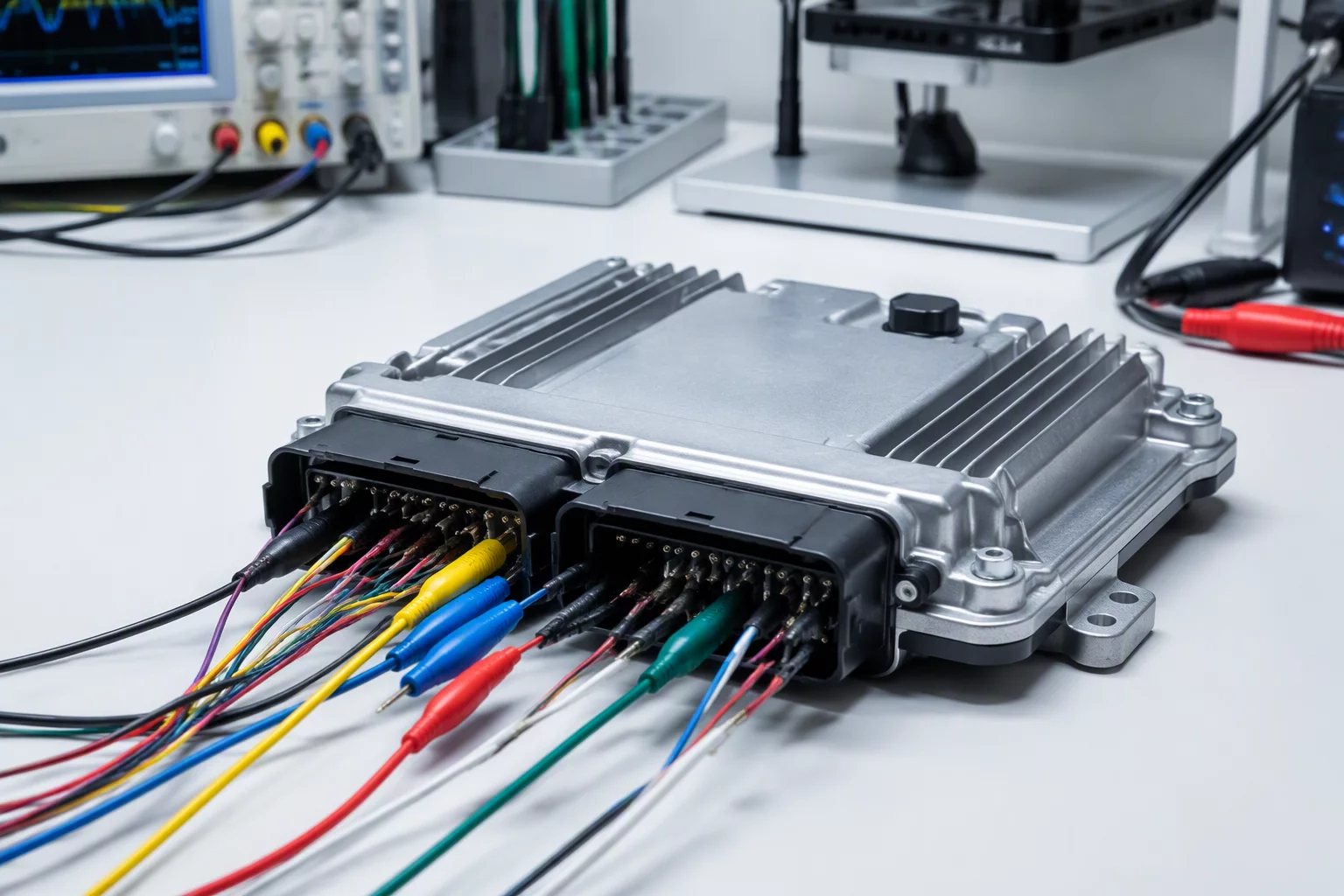
Core Architecture and CAN Bus Refinements
Haltech’s deployment of Firmware V1.36 represents a major maintenance and capability iteration for the Nexus R3 and R5 power management units. At its core, the update targets communication overhead across secondary CAN networks. When running complex telemetry chains—combining wideband controllers, electronic dashes, and auxiliary keypads—earlier firmware revisions exhibited sporadic message drops under maximum processor load. V1.36 reorganizes the microcontroller task scheduler to ensure mission-critical fuel and ignition triggers retain top priority.
Calibration engineers upgrading existing chassis calibrations must note that the CAN IO stream layout has been streamlined. While backward compatibility remains intact for legacy DBC setups, new channels now stream at native 100 Hz frequencies without requiring manual packet downsampling.
Critical Pre-Flash Checklist for Haltech Nexus V1.36
Before executing the firmware write via Nexus Software Programmer (NSP), follow these baseline preparation steps:
- Backup full hardware map (.nsp file) and export current runtime sensor tables.
- Verify external 12V battery tender connection to prevent brownout during bootloader execution.
- Recalibrate Drive-by-Wire (DBW) throttle stops and stepper motor idle zero-points immediately post-flash.
"Upgrading standalone engine firmware without verifying differential tables in NSP leaves unseen offsets in transient compensation registers."
Transient Fuel & Ignition Logic Overhauls
The secondary pillar of Firmware V1.36 focuses on wall-wetting and film evaporation algorithms under rapid throttle transients. Prior firmware revisions relied on static lookup decay multipliers that required significant manual dampening on large-plenum turbocharged setups. In V1.36, the transient fuel model incorporates manifold pressure derivative filtering, allowing tuners to achieve crisp throttle response without over-fueling during tip-in deceleration phases.
In addition, ignition angle trim behavior during gear shifts and electronic throttle blade limits has received smoother transition curves. The revised cut-and-retard sequence minimizes driveline shock during aggressive torque reduction requests, creating more predictable traction intervention on pre-programmed track layouts.
Hexadecimal Dump Differences & Parameter Matrix
A detailed binary dump comparison between Firmware V1.35 and V1.36 highlights significant refactoring in memory allocation tables. Specific register offsets responsible for secondary injection staging now operate on unified floating-point math, eliminating minute rounding variances observed during high-RPM duty cycle saturation tests.
| Parameter Dimension | Stock Calibration | Updated Revision | Validation Status |
|---|---|---|---|
| Primary CAN Refresh Rate | 50 Hz Fixed Limit | 100 Hz Configurable | Verified |
| DBW Transient Smoothing | Linear Fixed Step | Dynamic Polynomial Filter | Verified |
| Table Checksum Validation | Standard CRC16 | CRC32 + Digital Signature | Verified |
Implementation Protocols for Dyno & Track Validation
Deploying V1.36 onto active competition vehicles mandates a structured re-verification workflow. Following the bootloader update, every active table within the NSP calibration tree must be compared against the historical baseline file using the differential inspector. Pay special attention to auxiliary analog input scalings, as sensor calibration curves for third-party pressure transducers may experience micro-volt offset adjustments under the updated ADC sampling routine.
Once static hardware validation is documented in the calibration ledger, verify dyno transient logs across repeated sweep pulls. Confirm that lambda tracking accurately mirrors target AFRs across both rapid throttle stomps and gradual cruise tip-ins. All changes should be committed to the shop repository with complete version notes and cryptographic hash references.